
OPUS 26
Details
Summary :
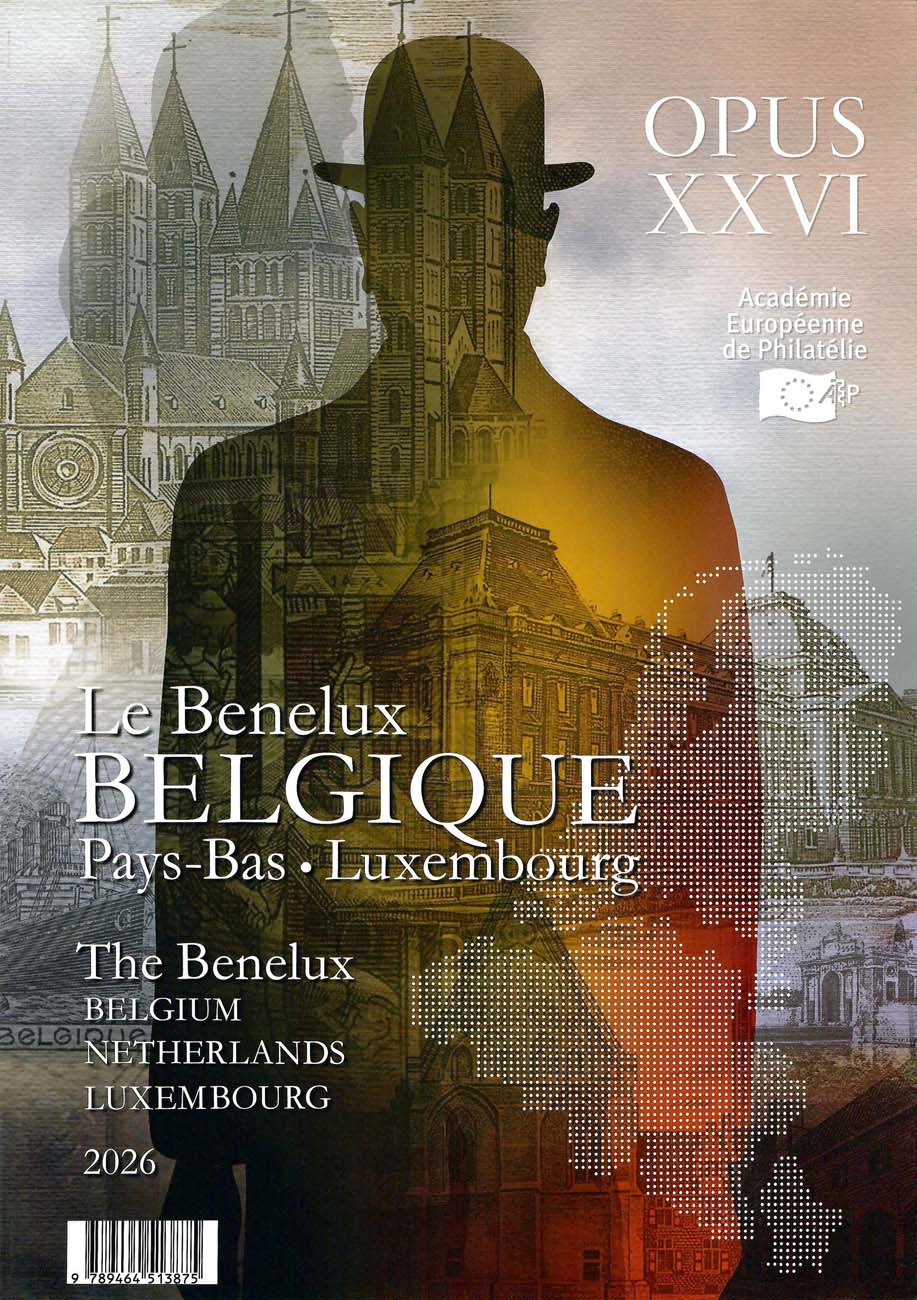
OPUS is AEP's flagship yearly publication. This 2026 edition is devoted to the Italian speaking countries, with 18 articles, summaries of which can be seen below:
1) Belgium: letters to and from Italy 1836-1859
Lorenzo Carra
The author once again presents us with rare and hard-to-find letters sent from Italy to Belgium or vice versa, between 1836 and 1859, which he describes with precision and detail. At that time, Belgium had just emerged and Italy was still divided into several small states. This makes his story fascinating.
2) Mail from Portugal to Belgium. A study of postal agreements, rates and routing (1853-1875)
Luis Rocha
The author presents a very detailed analysis of postal traffic between Portugal and Belgium between 1853 and 1875. Using numerous examples, he describes the successive postal conventions that regulated this postal traffic, the rates used and the different routes taken by this correspondence.
3) Quelques perles de la philatélie belge moderne
Hubert Caprasse
The author is one of the few philatelists interested in modern philately. With infinite patience, he has examined thousands of Belgian stamps of the “Numbers on Heraldic Lion” and “King Baudouin Marchand type”. He analyses all the details of the successive prints and describes the varieties, curiosities, roll stamps and postmarks, some of which are extremely rare.
4) Les coupons-réponse internationaux du modèle Rome en Belgique
Jean-Frangois Logette
The author analyses the various reply coupons that were used in Belgium, first from 1907 to 1920, then from 1927 onwards. He describes the tiny differences between the types of these reply coupons, which make it possible to place them chronologically.
5) From Sarajevo to Ypres
Mark Bottu
The author chronologically traces the military operations that took place in Belgium during the First World War, illustrating each stage of the German occupation with postage stamps, postcards and letters.
6) Postal Consequences of the 1870-1871 Franco-German War on Belgium
Steven Walske RDP
The author presents a large number of items dating from the Franco-Prussian War of 1870-1871 that are related to Belgium: items from the six balloons that landed in Belgium, letters addressed to Belgium and transported as balloon mail, Boules de Moulins, and a few very rare items that survived the sieges of Metz and Verdun or the Battle of Sedan.
7) Mail traffic between Belgium and Spain, from the accession of King Leopold I to the GPU (1830-1874)
Pol Wijnants
The author conducted painstaking research in postal archives to describe the treaties and numerous conventions that regulated postal traffic between Spain and Belgium, from Belgian independence until the creation of the General Postal Union in 1874.
8) Courrier par avion acheminé par la Belgique vers la Colombie : les lignes de la S.C.A.D.T.A.
Robert Lisabeth
The author shows us some nice pieces of correspondence from the interwar period between Belgium and Colombia, which used the services of S.C.A.D.T.A. (Sociedad Colombo-Alemana de Transportes Aéreos). He describes the routes taken and the rates used.
9) Belgique - Maroc par avion 1920-1921
Filip Van der Haegen
The author presents the different ways that existed in 1920-1921, in the early days of commercial aviation, to send correspondence from Belgium to Morocco. He shows us several letters, explaining the postage rates and describing the postmarks.
10) La Légion Belge au Mexique (1864-1867)
Jean-Claude Porignon
After a brief historical overview, the author presents some of the correspondence from Belgians who served in the Belgian Legion, sent to Mexico to protect the imperial couple (1864-1867). He analyses in detail the route taken by these letters which are extremely rare and sometimes unique.
11) La Société internationale de secours pour les prisonniers de guerre, Bruxelles 1870-1871
Dominique Hardy & Alain Israël
After presenting the history of this Society, created to make the fate of prisoners of war more bearable, the author shows two very rare letters sent from Brussels to France, with two different marks from the International Society for the Relief of Prisoners of War.
12) Coach and Mail on Rail 1830-1852. Coach and Travelling Post Offices between Belgium and Germany
James Van der Linden RDP
The author describes the birth of the railway in Europe, which was quickly seen as a fast means of transporting mail. He first analyses the early days of the postal service (the different routes, treaties, stations, tariffs, etc.) by rail between Belgium and Germany, and then shows us several of the very first letters that were sent in this way, analysing them in depth.
13) Le siècle d’or des Pays-Bas (1581-1672)
Guy Coutant
From 1581 to 1672, the Netherlands enjoyed such a flourishing period of political, economic and cultural prosperity that it is referred to as the country's Golden Age. The author begins by describing the historical aspects, including military and diplomatic successes, the development of the navy and the creation of a colonial empire. He then highlights some of the greatest achievements in art and literature, as well as the enormous progress made in science during this Golden Age of the Netherlands. It is illustrated by numerous postage stamps and postal documents.
14) Le Comité de soutien du DUBBELTJE BELGE pendant la première guerre mondiale
Charles Bruart
The author presents examples of correspondence relating to the DUBBELTJE BELGE, the National Relief and Food Committee created in the Netherlands during the First World War to provide financial and social assistance to the many Belgian refugees in the Netherlands, a nation that remained neutral during the global conflict.
15) A postal history of Westerbork Transit Camp
Jeffrey Groeneveld
The author describes life in the Dutch transit camp of Westerbork during the Second World War. For countless Jews, this camp was a waiting room for death, as it was almost always the starting point for the Nazi extermination camps. He analyses in detail how the postal service operated in the camp and shows us rare documents that bear witness to this sad period.
16) Holocaust in Holland: Ghost Letters
Kees Adema RDP
The author shows us letters sent during the Second World War from the Netherlands to the Westerbork camp or to the Polish Generalgouvernement. These letters never reached their addressees, who had either died in the camp or been transported to the extermination camps of the German Reich. The author describes the stamps and marks affixed to these letters, which are sad reminders of a horrific period in history.
17) The franking stamps of the Dutch Naval Heroes
Ruud Verberne
The author presents an in-depth study of the beautiful series issued by the Netherlands during the Second World War, dedicated to the great Dutch admirals whose exploits took place mainly in the 17th century. He describes the genesis of each stamp, which was often difficult due to the requirements of the German occupiers.
18) Stamps as political messengers in the Netherlands
Ton Dietz
The author has conducted an original study of all the postage stamps issued by his country, the Netherlands. He classifies them into several categories (dynastic, political, colonial, European, etc.) and analyses them according to the different periods and successive regimes in power.
19) Le courrier postal aérien luxembourgeois transitant par la Belgique avant 1940
Jacques Stes
As Luxembourg did not yet have adequate airfields, it had to turn to other countries to use the air route. Correspondence from the Grand Duchy first had to be sent to a neighbouring country with airfields. This is why these items had to be franked with stamps from these neighbouring countries in addition to Luxembourg stamps. The foreign stamps (Belgian, German, French) had to be bought and stuck on the item in Luxembourg, but would only be cancelled by the post offices of the foreign airports. The author shows nine very fine examples with Belgian stamps.
20) Les relais de la poste aux chevaux sur le territoire du Duché de Luxembourg de la ligne Bruxelles-Luxembourg à travers le courrier et les documents postaux 1681-1845
Vincent Schouberechts
The author describes the section of the postal route established by the Tours and Tassis family between Brussels and Luxembourg, located in the Duchy of Luxembourg. He shows us extremely rare letters and documents, most of which come from postmasters at the staging posts between Marche and Luxembourg.
21) Les premières utilisations des timbres au type “Armoiries” du Luxembourg (1859-1882)
Olivier Nosbaum & Marc Schaack
The authors present the results of extensive research into the first issues of Luxembourg’s “Coat of Arms” stamps. They provide a detailed analysis of the production, print runs and supply of these stamps. This analysis is accompanied by numerous rare examples of their first uses.
Return to the list of works